
“Life seems to go on without effort when I am filled with music.” – George Eliot
American Music Therapy Association -AMTA
Cambridge Centre for Music and Science
Scientists think that listening to music and spatial reasoning are related because they are processed similarly in the brain. Music activates a variety of areas in our brains but focuses primarily on the temporal, prefrontal cortex, and parietal.
Music therapy for children with special needs
Music therapy for heart problems- Harvard Medical School
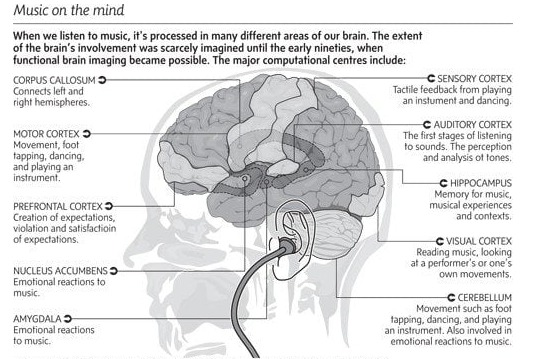
AREAS OF THE BRAIN IN MUSIC
Frontal Lobe
Temporal Lobe
Broca’s Area
Wernicke’s Area
Occipital Lobe
Cerebellum
Nucleus Accumbens
Amygdala
Hippocampus
Hypothalamus
Corpus Callosum
Putamen
RAGAS FOR THERAPY
Raga Malhar– Useful in the treatment of asthma and sunstroke.
Raga Shivaranjani– Useful for memory problems. Used for
treating patients with dementia and Alzheimer.
Raga Natabhairavi – It cures headache and psychological
disorders.
Raga Punnagavarali, Sahana – Controls anger and brings down
violence. Useful for Schizophrenia.
Raga Dwijavanthi – Quells paralysis and disorders of the mind.
Raga Sindhubhairavi– For a healthy mind and body; provides
peace, tranquility and serenity of mind.
Raga Hameer-kalyani – It relaxes tension with its calming
effect and brings down BP to normal.
Raga Brindavana Saranga-It increases the energy level.
Raga Mohana– Useful for the treatment of migraine headache.
Raga Amrutavarshini-It eases the diseases related to heat
Raga Madhyamavati– Clears paralysis, giddiness, pain in
legs/hands, etc. and nervous complaints.
For dopamine release “Clair de Lune” — Debussy
https://www.youtube.com/watch?v=4fvo_iOuSck&t=27s
Music medicine may be offered as an alternative to midazolam administration prior to peripheral regional anaesthesia. However, further studies are warranted to evaluate whether or not the type of music, as well as how it is delivered, offers advantages over midazolam that outweigh the increase in communication barriers.
https://rapm.bmj.com/content/44/8/796
Hearing a groove rhythm (GR), which creates the sensation of wanting to move to the music, can also create feelings of pleasure and arousal in people, and it may enhance cognitive performance, as does exercise, by stimulating the prefrontal cortex. Here, we examined the hypothesis that GR enhances executive function (EF) by acting on the left dorsolateral prefrontal cortex (l-DLPFC) while also considering individual differences in psychological responses.
https://www.nature.com/articles/s41598-022-11324-34-3
Music listening may have a beneficial effect on blood pressure, heart rate, respiratory rate, anxiety, and pain in persons with CHD. However, the quality of the evidence is not strong and the clinical significance unclear. Most studies examined the effects of listening to pre-recorded music. More research is needed on the effects of music offered by a trained music therapist.
https://pubmed.ncbi.nlm.nih.gov/19370642/
 Territorial Command of Grand Priory of The EMH Order Knights of St John of Jerusalem